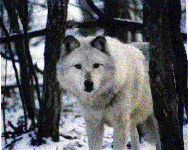
Photo (c) Timberwolf Alliance
Author: Terri Hanson
Grade: 7
Objective: Students will examine and evaluate different perspectives of human and wolf interaction and develop a conclusion based on their research through the use of electronic resources.
Wisconsin Model Academic Content
Standards:
Social Studies A.8.5.7 Investigate and
compare uses of natural resources in different regions for various purposes
Social Studies A.8.11.7 Analyze global
issues to predict consequences and determine possible solutions
Social Studies E.8.3.7 Describe the ways
in which local, regional and ethnic cultures may influence the everyday
lives of people
Wisconsin Model Academic Technology
Standards:
B.8.4 Evaluate and select information from a
variety of print, nonprint and electronic materials
B.8.5 Use media and technology to create and
present information
B.8.7 Communicate the results of research
and inquiry in an appropriate format
Lesson
Materials: Various news articles about wolves, maps that feature vegetation, population, and other geographic features of the Midwest, video camera, TV, computers and internet capabilities, Game: Managing Our Natural Resources
Time: Two Weeks
Introduction: The unit called, Gaining Perspective, incorporates technology, research skills and an integration of all seventh grade curricular classes into a final product where students have to use, apply and draw conclusions based on their research. This unit is centered around the interaction of humans and the environment, specifically in regards to the relationships between wolf populations and the people of the Midwest.
Sequence of Instruction:
Research Step
1. Students will identify, map and label
the physical features, climate, vegetation and population regions of the
Midwest. From this, students should predict areas where they think
the timber wolves of Wisconsin, Minnesota and Michigan could successfully
live.
2. Using maps that show location of the timber wolves in these Midwest states, students will compare their original thoughts to where successful wolf packs have been reported.
3. Next, students will look at collected newspaper articles dealing with topic of wolves in these states. Students should determine the focus and purpose of these articles, as well as if there is a positive or negative viewpoint of wolves in stated by the articles.
4. Students should then determine their own hypothesis of what they think various sources will show: positive human and wolf interaction or negative human and wolf interaction. The students' original hypothesis or viewpoint should be recorded.
5. Students will then use internet sources to locate information about human and wolf interaction. A brief summary of their sources and an accurate web citation should be included on this recording sheet. They will find information for three categories: General Wolf Information, Sources That Support The Original Hypothesis, and Sources that Oppose The Original Hypothesis. A minimum of five web sites should be used.
6. From the information collected, students will determine the viewpoint the majority of the sources show about human and wolf interaction. This conclusion may be either the same or different from their original hypothesis. Their learning should allow them to form their own educated opinion about this complex and controversial topic.
Application of Research
1. Students will play the game, Managing Our Natural Resources. This game allows them to play the roles of both environmentalists as well as the leaders of large lumber companies. Their choices, along with the lack of predictability in nature, will determine the success of the wolf population.
2. Students will develop a five minute news broadcast to deliver to the classroom. They will work in groups of four or five students that have the same original viewpoint or hypothesis. The news broadcast should contain a small amount of general information about wolves, examples of both positive and negative human and wolf interaction, and a general conclusion stated by the group. A grading rubric will be determined by the class prior to the broadcast and each broadcast will be scored by the class. These presentations will be video taped to enable the students to see all of the other news broadcasts.
3. Each student will produce a final product
that incorporates the information that they have uncovered in their research.
Students can choose the type of project that they would like to complete.
These choices could include a poster,
written report, Powerpoint presentation, Hyperstudio
stack, mobile, speech, diorama or any other type of project that is acceptable
to the teacher. The project must include the following components:
student's original hypothesis or viewpoint, general information about the
wolf or wolf population, sources that both support and don't support their
original hypothesis, and a general conclusion about their personal learning.
Closure:
On the final day of the unit, students will present their
projects to the class. Discussion of the students' learning will
conclude the learning.