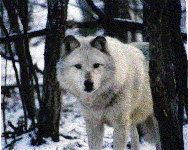
Photo (c) Timber wolf Alliance
Author: Kim Wardean
Grade: 7
Content area: Language
arts
ïThis lesson is part of an interdisciplinary
unit celebrating Wolf Awareness Week.
Objective: To analyze the stereotyping of wolves in children's literature and compare the stereotype to facts about wolves. Students will then rewrite a fairy tale from the wolf's point of view.
Wisconsin Model Academic Content
Standards:
Language Arts A.B.1 Create or produce writing
to communicate
Language Arts B.8.2 Plan, revise, edit,
and publish clear and effective writing
Wisconsin Model Academic Technology
Standards:
B.8.4 Evaluate and select information from
a variety of print, non print and electronic materials
A.8.3 Use a computer and productivity software
to organize and create information
Lesson
Materials: Children's books: The Three Little Pigs, Little Red Riding Hood, The True Story of the Three Little Pigs, The Fourth Little Pig, and The Three Little Wolves and the Big Bad Pig.
Time: 6 class periods
Introduction: In this set of lessons, students will read fairy tales in which wolves are stereotyped. Students will then compare the stereotype to facts about wolves. Finally, they will rewrite a fairy tale from the wolf's point of view.
Sequence of Instruction:
1. Brainstorm student preconceptions of
wolves on a chart. Discuss why they have these preconceptions.
2. Discuss the concept of stereotyping.
3. Read children's fairy tales such as
the Three Little Pigs and Little Red Riding Hood and point
out the stereotyping of the wolf being "big and "bad. Students will
note how the wolf is portrayed incorrectly.
4. Read and discuss the book The True
Story of the Three Little Pigs which tells the familiar tale from the
point of view of the wolf asserting his innocence.
5. Read and discuss the book The Fourth
Little Pig in which a sister shows the pigs how silly they are for
fearing the wolf.
6. Read and discuss the book The Three
Little Wolves and the Big Bad Pig in which the character roles are
reversed, and the wolves are the victims.
7. Have students rewrite the story of Little
Red Riding Hood from the wolf's point of view.
8. Using the writing process, have students
compose, edit, and revise stories using Microsoft Works 4.0 or Microsoft
Word.
9. Have students create story covers using
scanned or imported images.
Closure:
Students will read their stories to the class
and then post them on the school's web page.